Beyond Syntax: How AIAD is Shifting the Core Constraint of Software Development
A Software professional's take on AI-Augmented Development and what it means for your career right now.
Let me start with a scene for you.
It's 9am. You sit down, open your IDE, and instead of staring at a blank file trying to remember how you wrote that database helper six months ago, you just describe what you need. Out comes the code. You review it, tweak it, ship it. Before lunch.
That's not a fantasy pitch from a startup deck. That's a Tuesday for developers who've genuinely embraced AI-Augmented Development. And if you're in software and haven't started treating this shift seriously, you're already behind the curve. Not because I'm trying to alarm you, but because the developers who are adapting are measurably outproducing those who aren't.
This post covers exactly what AIAD is, how we got here, what it changes about your daily work, and what you need to do differently to stay relevant. No panic, no hype. Just a clear eyed view from someone who has spent years designing and building software systems and knows the difference between a passing trend and a structural shift in how this profession works.
This is a structural shift.
What AIAD Actually is? (and Isn't)
AI-Augmented Development (AIAD) is the practice of using artificial intelligence tools to help you build software faster and better. The operative word is augmented. You remain in the pilot's seat. The AI is a highly capable co-pilot. It monitors the instruments, handles the checklists, flags the anomalies, and absorbs the cognitive overhead so your judgment stays sharp for the decisions that actually matter.
What it is not is a replacement for developers or engineers. That's not a comforting spin, it's technically accurate. AI tools today have no understanding of why your system needs to exist, who it serves, what trade-offs are acceptable given your business constraints, or what "good enough" looks like in your specific context. Those are judgment calls. They stay with you, and they always will.
Think of it this way, a GPS doesn't replace the driver. It eliminates the navigation cognitive load so the driver can focus on actually driving. Reading traffic, handling the unexpected, making the calls the map can't make. AIAD does exactly the same thing for code. The developer who understands this distinction will thrive. The one who doesn't, either over trusting the AI or refusing to engage with it won't.
A Timeline Worth Understanding
Understanding the history here matters, because it explains why this moment is categorically different from the previous waves of "AI will change coding" predictions that never quite delivered. We didn't arrive at capable AI assistants overnight. This built up in deliberate layers, and each layer did something important. It trained us to work with machines.
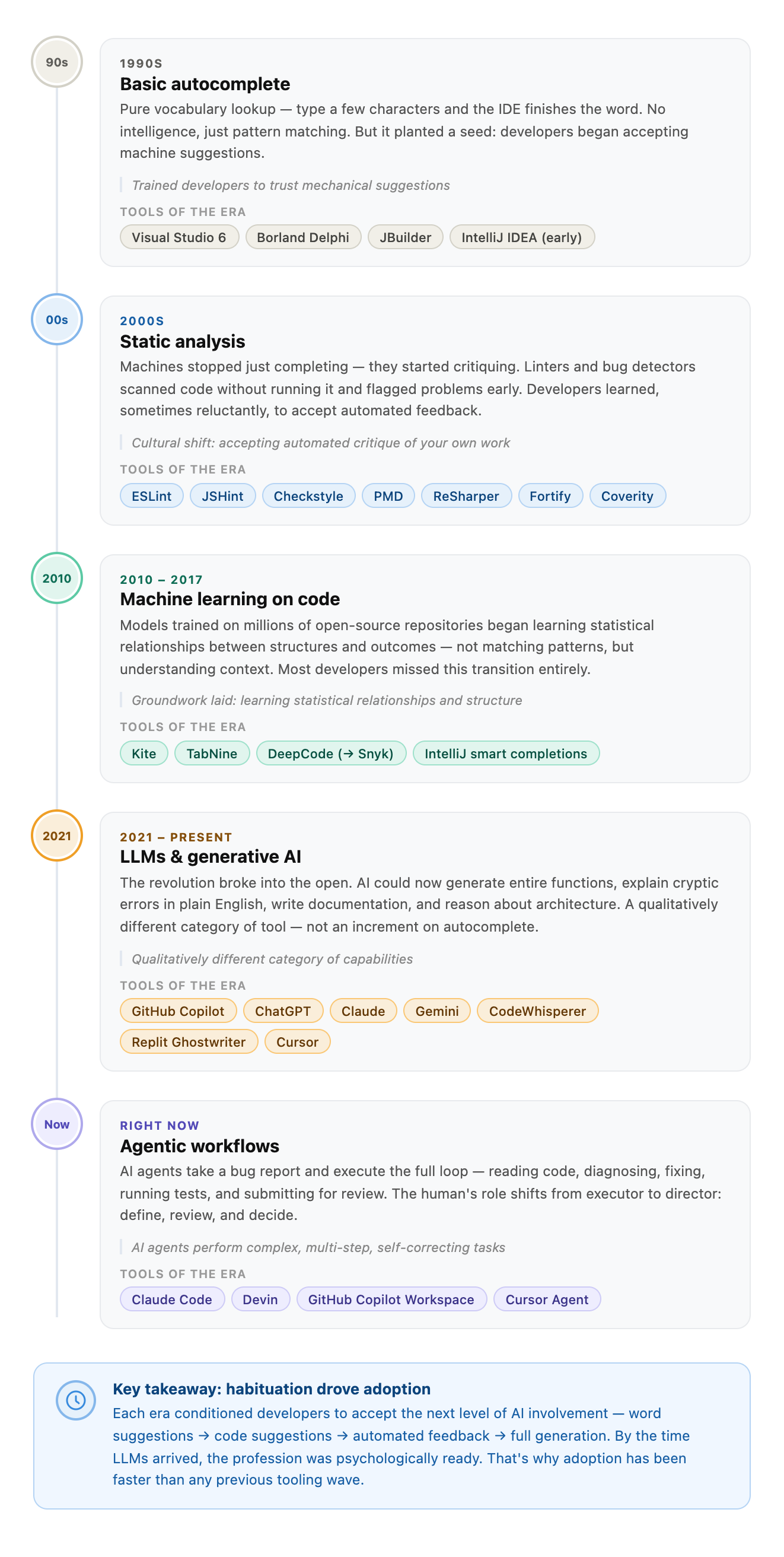
In the 1990s, we had basic autocomplete. Type the first few letters of a method name and your IDE would finish it. Useful and mechanical but pure pattern matching, no intelligence behind it.
Through the 2000s, static analysis tools arrived. Linters, code style checkers, and early bug detectors that could scan your code without running it and flag likely problems. This was the first time machines were giving developers feedback, not just completion. We learned, sometimes reluctantly to accept automated critique of our own work. That was a cultural shift as much as a technical one.
From 2010 to 2017, the field underwent a transformation that most developers, heads down in their own codebases, didn't fully register. Machine learning models began training on millions of lines of open source code. They weren't matching patterns anymore. They were learning statistical relationships between structures, contexts, and outcomes. The groundwork for everything that followed was laid quietly here.
Then came 2021, and the revolution broke into the open. GitHub Copilot launched. Then ChatGPT. Then Claude. Suddenly, AI could generate entire functions that were contextually coherent, explain a cryptic stack trace in plain English, write documentation, and reason about architectural alternatives. These weren't incremental improvements on autocomplete. They were qualitatively different tools representing a different category of capability entirely.
And right now, we're watching the next leap: Agentic workflows. More on that below.
The history matters for one key reason: each era habituated developers to the next level of AI involvement. We accepted word suggestions, then code suggestions, then automated feedback. By the time LLMs arrived, we were psychologically ready in a way we simply wouldn't have been in 2005. That habituation is real, and it's precisely why adoption of tools like Github copilot and Claude has moved faster than any developer tooling wave I've seen in my career.
What Your Day Actually Looks Like With These Tools
Here are the five concrete ways AIAD reshapes daily development work. Organised not as a random list, but around the type of cognitive load each one removes, because that's what actually matters.
Writing code you already know how to write. This is the single biggest time sink AIAD eliminates first. Every experienced developer has written hundreds of slightly different CRUD functions, form validators, API wrappers, and utility helpers. You already know what they need to do. You just have to type them out. AI handles this class of work reliably. Describe the function's purpose, get a draft, review and adjust. What used to take 25 minutes takes 5. That time compounds across a week, a month, a year.
Catching what you missed before review. Before your code reaches a colleague, run it past an AI that will look for security vulnerabilities, logical inconsistencies, and edge cases you didn't consider. This isn't a replacement for human code review. It's a quality floor that consistently raises what enters review in the first place. Your colleagues stop flagging the obvious issues. The conversations become more substantive. That's a real improvement in team throughput.
Writing documentation. Most developers, and I include myself here, find documentation tedious in a way that causes it to get deprioritised. AI changes the calculus completely. It reads your code and produces coherent descriptions of what each function does, what parameters it expects, and what it returns. The output typically needs editing, but the blank-page problem disappears. Documentation such as readme files actually gets written. That matters more than most developers acknowledge, because undocumented code is a hidden form of technical debt.
Debugging with a genuine thinking partner. Paste an error message and ask what's happening. You get a plain English explanation, a root cause hypothesis, and a concrete fix in 90 seconds instead of 20 minutes of Stack Overflow archaeology. This is especially powerful for errors in libraries or frameworks outside your daily expertise, where you'd otherwise burn significant time just establishing context.
Pressure testing architectural decisions. This one consistently surprises people, but AI tools are genuinely useful as a sounding board for system design. "Should I use an event-driven pattern or request-response for this workflow?" is a question worth asking out loud. The response will surface considerations you might not have explicitly articulated, even if you'd have landed there eventually. Thinking alongside an AI is faster than thinking alone.
When AI Doesn't Just Suggest, It Executes
This is where the pace of change is most underestimated, and where I want to be direct. Most developers are not thinking seriously enough about what agentic AI means for the profession.
We're now seeing Agentic workflows. Tools like Claude Code and Devin that represent a qualitative step beyond "AI suggests, human implements." An AI agent can take a bug report, just a description of a problem and execute the full workflow without hand holding. Reading the relevant code, diagnose the issue, write the fix, run the test suite to confirm nothing regressed, and submit the result for human review.
The human's role in that loop hasn't disappeared. It has shifted to something harder and more valuable. You define the task with precision. You review the agent's output with genuine critical attention. You decide whether to accept, redirect, or escalate. That requires a different and frankly more sophisticated skill set than the one needed to execute the task yourself.
This is why I argue consistently that prompt engineering is, at its core, requirements engineering. The reason vague prompts produce mediocre AI output is identical to the reason vague requirements produce bad software. The system optimises for what you specified, and if you specified the wrong thing, you get the wrong thing delivered efficiently. Developers who already write clear acceptance criteria, articulate system behaviour precisely, and think carefully about constraints will adapt to agentic workflows faster and more naturally than those who don't.
The Three Skills That Actually Matter
The question everyone in this field should be asking is what it means to be a great developer in an AIAD world. Based on everything I've observed working with these tools and watching how teams adapt or fail to adapt, it comes down to three things.
Prompt engineering as a first-class skill. This is the discipline of giving AI tools instructions that are precise, contextual, and bounded. It means providing the right background without burying the AI in noise, specifying what you explicitly don't want, using examples to anchor the output, and breaking complex tasks into steps the AI can follow reliably. The strongest AI users aren't the ones who experiment with the most prompts. They're the ones who think most clearly about what they need before they type anything. That clarity is the skill.
Elevated critical review. When you write code yourself, you have an intuitive map of where the risks are, because you made the choices. When AI writes code, you're reviewing output from a system with no stake in the outcome and no understanding of your production environment. It will produce plausible looking nonsense with the same confidence it produces correct code. You must read AI generated code more sceptically than your own, particularly around security assumptions, edge case handling, and environmental dependencies. This is non-negotiable.
Strategic thinking over execution. As AI absorbs more implementation work, the premium on thinking clearly about what to build and why rises, it doesn't fall. System design, domain modelling, technical trade-off analysis, translating user needs into architectural decisions remain stubbornly human problems. And as execution becomes cheaper, these judgment intensive skills become proportionally more valuable. The developers who invest in them now will be disproportionately rewarded.
The Failure Modes You Need to Know
No credible treatment of AIAD skips the failure modes. AI tools are genuinely powerful, and they are genuinely fallible. Ignoring either half of that statement causes problems.
AI hallucination is real, subtle, and dangerous. Hallucination is when an AI confidently produces something wrong, a function that doesn't exist in the library, an API call with incorrect parameters, a security recommendation that sounds authoritative but isn't. The critical danger is not that the output looks broken. It's that it looks entirely reasonable. You will only catch it through genuine critical review, not a cursory scan. Teams that rubber stamp AI output will ship bugs and vulnerabilities that their pre-AI processes would have caught.
Humans own the strategy, full stop. AI tools execute bounded, local tasks well such as write this function, fix this bug, document this class. They are incapable of understanding your product's full context, your team's constraints, your users' actual needs, or the long-term architectural implications of today's choices. Those remain human responsibilities. Use AI for the leaves of the decision tree. The trunk stays with you.
Security demands explicit, consistent attention. AI generated code routinely includes insecure defaults, outdated patterns, and approaches that are functionally correct but exploitable. This is not a reason to avoid AI generated code. It is a reason to treat every line of it as unvetted code from an unknown contributor and apply your full security review process without exception. Teams that adopt AI tools without updating their security practices are expanding their attack surface without realising it.
The Bigger Picture
Software development has always had a binding constraint, the thing that limits how much you can build. For most of computing history, that constraint was how fast you could write correct code. Typing speed, syntax memory, debugging skill, API knowledge. Implementation bandwidth was the scarce resource.
AIAD is moving that constraint, and this is the most important thing to understand about the current moment. Implementation is becoming cheaper. The new scarce resource is clear thinking. The ability to define precisely what needs to exist, why it matters, how it should behave, and how to verify that it's actually good. That's a harder, more interesting problem to be constrained by.
Put plainly: software development is becoming more about solving human problems and less about wrestling with syntax. Having spent years in this field working on systems that touch real people's lives, I have a good idea about which version of the job is more meaningful. We're moving toward it.
The developers who recognise this shift and invest accordingly, in judgment, in communication, in system-level thinking, will find this an extraordinarily good time to be in this profession. The ones who don't will find it increasingly difficult to differentiate themselves. That's not speculation. It's already visible in the teams doing this well.
Where to Start?
If you've been watching from the sidelines, here is a direct on-ramp.
Start with an AI-native editor like Cursor, which integrates LLMs directly into your coding environment rather than treating them as a separate window you tab to. Explore agentic tools. Claude Code is the clearest current demonstration of what end to end AI task execution looks like in practice. Begin with low stakes work such as documentation, test generation, explaining unfamiliar code. Use those early experiences to build a reliable intuition for where AI output is trustworthy and where it needs the most scrutiny before you apply these tools to higher stakes decisions.
The goal is not to let AI do your job. The goal is to become a developer who can direct AI so precisely and critically that your combined output exceeds what any purely human developer could produce working alone. That developer is not less valuable. That developer is the most valuable person on most teams today.
The future is not arriving. It is already running in production. The question is whether you're the one directing it.